
To make the world… “An incredibly grueling game—we were dominated in many areas”
Rot-Weiss Essen managed to secure a lucky point against VfB Stuttgart II just before the final whistle. Uwe Koschinat was quite satisfied with the 1-1 draw.
16,187 spectators came to the stadium on Hafenstraße on Friday evening to watch Rot-Weiss Essen win. Okay: Maybe not the 87 fans who came from Stuttgart. They saw a strong group of young players from VfB.
The RWE fans, too, will remember such highly talented gems as Mansour Ouro-Tagba, Samuele Di Benedetto, Lauri Penna, Noah Darvich, or Efe Korkut—and may continue to follow their careers.
After all, what the Stuttgart U23 team showed at Hafenstraße was truly commendable. Bold, skillful, and dominant: that’s how Nico Willig’s team presented itself.
No wonder he had a hard time accepting the 1-1 draw. He told “Magenta Sport”: “I’m not satisfied with the 1-1. We played a great away game. We kept the opponent so far away from our goal for 87 minutes. There were no critical situations in front of our net. That was strong. Unfortunately, only until the 87th minute.”
That was an incredibly grueling game for us. We were outplayed in many areas. It was very exhausting for the team to constantly chase after the Stuttgart players during their many long stretches of possession. A point like this is definitely worth something at this stage of the season
Uwe Koschinat
Uwe Koschinat, on the other hand, was satisfied with the closing stages. Once again, he proved he had a knack for making the right substitutions by bringing on Marek Janssen. First, Ahmet Arslan missed a penalty, and in the very next play, substitute Janssen converted a cross to make it 1–1—his third goal as a substitute and Essen’s twelfth goal of the season off the bench.
Unlike Willig, Koschinat was quite content with the 1–1 draw. Even the RWE coach had to acknowledge Stuttgart’s dominance. “That was an incredibly grueling game for us. We were outplayed in many areas. It was very exhausting for the team to constantly chase after the Stuttgart players during their many long stretches of possession. A point like this is definitely worth something at this stage of the season,” Koschinat noted.
Felix Wienand, who filled in for the ailing Jakob Golz, received special praise: “He made some very strong saves in many situations. He only found out that morning that he’d be playing. That was really impressive.”
Bitcoin is nearing its limit: Only 5% remains to be mined
With less than 5% of BTC remaining to be mined, Bitcoin confirms its programmed scarcity. Unlike other blockchains with changing monetary rules, Bitcoin remains faithful to its original protocol. This stability reinforces its unique position: a tamper-proof digital asset, designed to counter inflation and censorship.
95% of BTC has already been mined—as expected, it is becoming scarcer
It is important to remember that Bitcoin is unique among digital—and even physical—assets: its monetary policy is immutable and transparent, and its transactions are, of course, censorship-resistant.
Whereas many blockchains regularly adjust their economic rules (changes to token issuance, operation, and usage), Bitcoin is based on code that is virtually set in stone and has been audited. No single entity can impose a change without the explicit consent of the entire network.
It is precisely this robustness that has allowed Bitcoin to guarantee, since its inception, a maximum supply of 21 million units—a certainty that few other cryptocurrencies can offer.
Today, the 95% threshold of the maximum supply of bitcoins has been reached, amounting to nearly 19.96 million BTC. There are now only about 1.04 million BTC left to mine—a scarcity that will continue to increase over time, until the final issuance, expected between 2130 and 2140.

However, the scarcity perceived by the market is actually even greater; it is estimated that 3 to 4 million BTC are permanently lost due to lost or destroyed private keys.
Added to this are the famous BTC held by Satoshi Nakamoto, the mysterious creator of Bitcoin: approximately 1.125 million BTC, mined in the network’s early months and never moved since.
The majority of the community considers these BTC to be out of circulation forever. Taking these losses into account, the actual available supply could thus drop to around 16 million BTC, or even less.
What if someone stole Satoshi’s BTC?
Although the 1.125 million BTC attributed to Satoshi Nakamoto are considered permanently lost, some Bitcoiners believe there remains a slim chance they might one day be recovered.
Two scenarios are frequently discussed:
The first is based on an entropy flaw during the generation of private keys in Bitcoin’s early days. If the private key generation algorithm used by Satoshi lacked sufficient randomness, then well-equipped attackers could, in theory, recover some of these keys using a brute-force attack.
The second scenario involves quantum cryptography. A sufficiently powerful quantum computer could break classical cryptographic algorithms, such as ECDSA, which Bitcoin uses to secure private keys. This type of threat is still very theoretical, but it poses an existential question for all systems based on current cryptography; Bitcoin would not be the first victim of such computers.
New FUD on Tether — Could Diversification into Gold and Bitcoin Spell Its Downfall?
Despite its undeniable successes and the clout of its USDT stablecoin, Tether remains the perennial crypto giant that everyone loves to bash. The latest example: a doomsday scenario imagined by Arthur Hayes regarding its diversification into gold and Bitcoin.
Tether: Could Diversification into Gold and BTC Make USDT Insolvent?
The growth of the cryptocurrency sector has already given rise to several giants, including the undisputed leader of the stablecoin market, Tether, and its USDT, currently valued at $185 billion—representing more than 60% of the market share.
This position has been achieved despite frequent criticism regarding its high level of centralization, as well as the management of its reserves, which is considered too opaque. As a result, the company continues to rack up successes and profits while simultaneously being excluded from major regulatory jurisdictions such as the European Union and the United States.
A paradox that has fueled widespread speculation about its true strength—or its ability to guarantee the solvency of its USDT stablecoin. This question has recently been brought back into the spotlight by investor Arthur Hayes, who views the current situation as “the beginning of the first rounds of a massive interest rate trade.”
Indeed, the co-founder and former CEO of the cryptocurrency exchange BitMEX believes that Tether’s latest quarterly report highlights a corporate strategy designed to counter a potential cut in Fed rates, “which would crush the interest income” from its reserves, which are heavily exposed to U.S. Treasury bills.
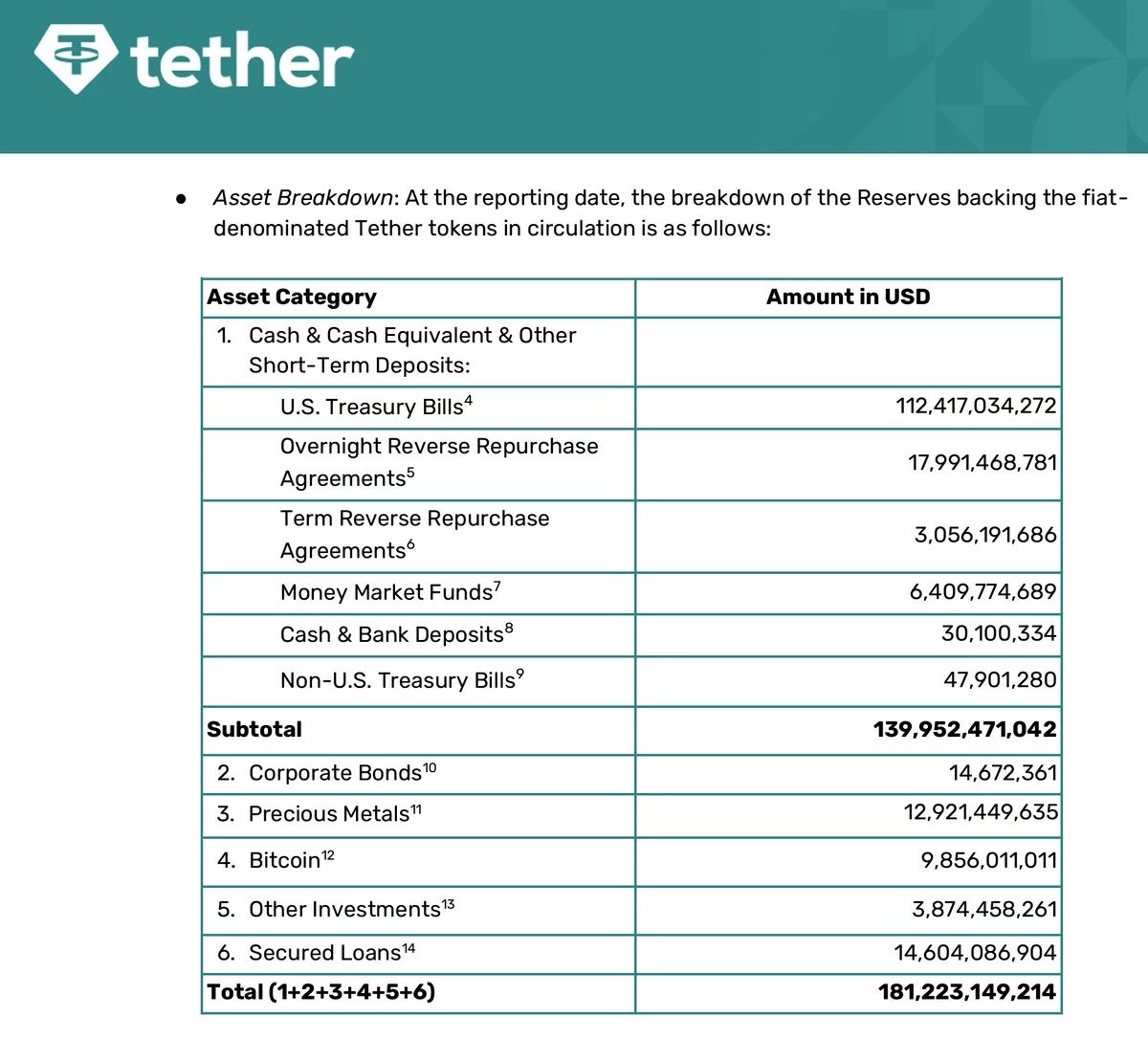
In response, they are buying gold and BTC, which should theoretically skyrocket in value as the price of silver falls. But a drop of about 30% in these positions would wipe out their capital, and then the USDT would theoretically become insolvent.
Arthur Hayes
New FUD Against Tether, According to CEO Paolo Ardoino
With this post, Arthur Hayes appears to be predicting the imminent insolvency of USDT, linked to the current decline in Bitcoin and the correction in the price of gold since its last peak—all due to Tether’s diversification policy, which is supposed to ensure greater stability.
A new attempt at FUD against Tether, according to its CEO Paolo Ardoino, orchestrated by “certain influencers who are either bad at math or incentivized to promote [its] competitors.” And for good reason: its latest quarterly report also notes that “Tether will continue to maintain a cushion of excess reserves amounting to several billion dollars and the Group’s total equity approaching $30 billion .”
A doomsday scenario also called into question by Joseph Ayoub, former head of crypto research at Citi, after “spending hundreds of hours writing research on Tether .” Indeed, he explains how the reported assets differ from the company’s actual assets and how Tether stands out as “one of the most cash-generating companies in the world” with only 150 employees.
All of this allows us to estimate the value of their equity somewhere between $50 billion and $100 billion. Even though they’ve indicated they’re seeking to raise $20 billion at a 3% stake, which would value them at around $500 billion. That’s unlikely to happen, and it’s undoubtedly an overvaluation, but it’s still very valuable equity.
Joseph Ayoub
Just an attempt at market manipulation?
All these denials cast doubt on Arthur Hayes’ claims, which are considered alarmist, to say the least. This is especially true given his recurring attempts to sway the market in his favor, coupled with a stated desire to see “the mainstream media go wild over this.”
Could this instead be a strategy designed to trigger a more significant decline in the crypto market, with the aim of finding a good entry point? This is a possibility very clearly considered by Ki Young Ju, founder and CEO of the analytics firm CryptoQuant:
Translation: I’m currently in a bad position, and I want crypto prices to fall so I can buy at lower levels.
Ki Young Ju
This is a serious question.
Strategy’s CEO is considering the possibility of selling Bitcoin to pay dividends
The current decline in Bitcoin is not good news for Digital Asset Treasuries (DAT), which specializes in accumulating the most iconic cryptocurrency. This reality is even prompting the CEO of industry leader Strategy to consider selling a portion of its BTC to pay dividends to its shareholders.
Strategy has nothing to do with a “hyper-dilutive Ponzi scheme”
The current downturn in the cryptocurrency market is putting the Digital Asset Treasuries (DAT) sector through a full-scale stress test, a sector that has seen unprecedented growth since the beginning of the year.
Indeed, these publicly traded companies—which have become specialists in crypto accumulation, with financial structures that are sometimes (very) shaky—find themselves in a very precarious position facing shareholders seeking higher returns based on supposedly attractive holdings-per-share ratios (mNAV).