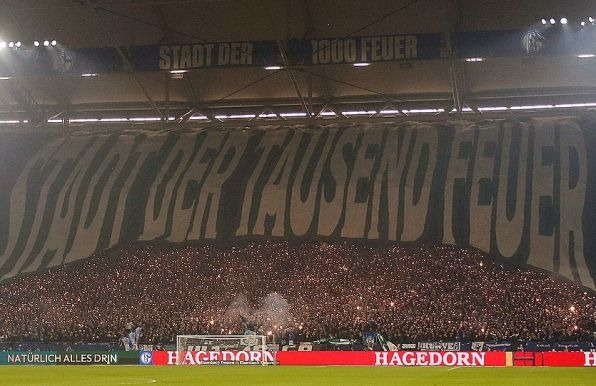
The North Rhine-Westphalia clubs from Cologne, Bochum, and Gelsenkirchen are appealing to politicians to find joint solutions to the issue of safety in stadiums. The three clubs reject collective punishments.
In recent weeks, many first division stadiums have been silent. At least for the first twelve minutes. Numerous fan groups had previously criticized planned measures by politicians at the upcoming Conference of Interior Ministers (IMK) in Bremen as blanket suspicion.
Some points are now off the table. According to Bremen’s Interior Senator Ulrich Mäurer (SPD), personalized tickets, comprehensive ID checks, facial recognition, AI surveillance, and pyrotechnics are not on the agenda of the three-day conference.
This took some of the heat out of the issue. On Thursday, 1. FC Köln, FC Schalke, and VfL Bochum issued a joint statement on the current debate about stadium security and the deliberations of the Conference of Interior Ministers.
The statement says that for the clubs signing it, a lively and diverse fan culture is part of the clubs and their traditions. At the same time, of course, the protection of all stadium visitors is an absolute priority. And the two aspects belong together.
Only a continuous, fact-based dialogue can create a balance between high security and a lively fan culture.
Schalke, VfL Bochum, 1. FC Köln
The statement explains: “In the run-up to the IMK, we are already in close contact with political leaders – especially at the state level. The clubs in North Rhine-Westphalia are also coordinating closely with each other, with the associations, and with the relevant German soccer committees. Our main concern is to make the discussion more objective. Because we are convinced that only a continuous, fact-based dialogue can create a balance between high security and a vibrant fan culture.”
The clubs emphasize that the stadium experience in German stadiums is safe, with the figures speaking for themselves. However, they understand that politicians are also under pressure due to the large number of officials who have to accompany the games. The three clubs write: “These issues were discussed intensively between the DFB, DFL, interior ministries, and police authorities in the Federal-State Open Working Group (BLoAG). For us, it is clear that stadium bans must be based on verifiable facts. They are subject to the principle of proportionality, and the rights of those affected must be preserved. There must be no automatic mechanism whereby a mere initial suspicion results in a stadium ban.”
In general, the three clubs are opposed to collective punishments and appeal to politicians to work together to find solutions. Ultimately, safety must be ensured, but the “unique fan culture” must be preserved. The full text of the letter Joint statement by North Rhine-Westphalian soccer clubs on the current debate on stadium safety and the deliberations of the Conference of Interior Ministers.
The soccer clubs in North Rhine-Westphalia are following the nationwide discussion on stadium safety, fan culture, and possible new measures by the Conference of Interior Ministers (IMK) with great attention. For the signatories of this statement, one thing is clear: the lively and diverse fan culture is an essential part of our clubs and our shared soccer tradition. At the same time, the protection of all stadium visitors is our top priority. Both aspects belong together and must not be played off against each other. In the run-up to the IMK, we are already in close contact with political leaders – especially at the state level. The clubs in North Rhine-Westphalia are also coordinating closely with each other, with the associations, and with the relevant German soccer committees. Our main concern is to make the discussion more objective. We are convinced that only a continuous, fact-based dialogue can create a balance between high security and a vibrant fan culture. The current debate is taking place even though the stadium experience in Germany is demonstrably safe, as evidenced by figures from the Central Information Office for Sports Operations (ZIS). At the same time, we recognize that the high deployment of police resources poses challenges for policymakers. However, the measures currently under discussion go far beyond what is necessary and would deeply interfere with fan culture, club autonomy, and the rights of visitors.
These issues have been discussed intensively between the DFB, DFL, interior ministries, and police authorities in the Federal-State Open Working Group (BLoAG). For us, one thing is clear: stadium bans must be based on verifiable facts. They are subject to the principle of proportionality, and the rights of those affected must be protected. There must be no automatic mechanism whereby a mere initial suspicion leads to a stadium ban. In addition, security in stadiums is a local responsibility. Each location has a special responsibility towards its own fans, the urban community, and soccer as a whole. We welcome the agreed strengthening of the clubs’ security and prevention work. This starts where security actually begins: in the coordinated interaction of all local partners. We expressly oppose blanket and collective restrictions—such as comprehensive ticket personalization, curtailing the work of local stadium ban commissions, or general interference with the rights of visiting fans. Instead, we focus on evidence-based, differentiated measures and on trusting cooperation between clubs, fan projects, fan scenes, authorities, and associations. This is the only way to achieve prevention, effectiveness, and acceptance in equal measure.
We appeal to political decision-makers to work with us to shape this path. Developments in recent years clearly show that objectivity, prevention, and local responsibility achieve more sustainable results than blanket tightening of restrictions. The goal of all those involved must be to further strengthen security while preserving the unique fan culture that has shaped German soccer for decades.
We will accompany the further process of the Conference of Interior Ministers constructively, critically, and resolutely—with the clear aim of bringing together safety and fan culture and conducting the debate on an objective basis.
1. FC Köln
Schalke 04
VfL Bochum