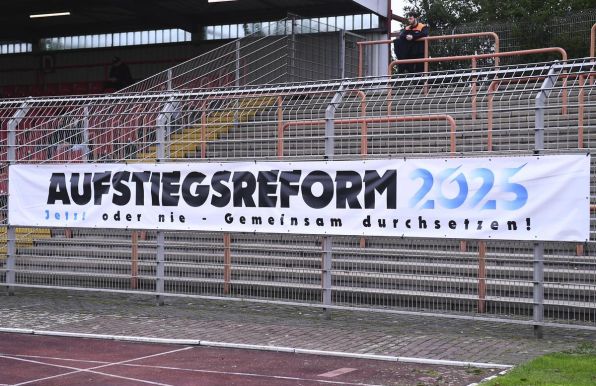
Two possible models have been identified for the Regionalliga reform. The “Promotion Reform 2025” initiative clearly supports one solution. The other is firmly rejected.
On Wednesday, the “Regional League Reform” working group appointed by the German Football Association (DFB) met for the fifth time in Frankfurt. The 13-member panel, chaired by Dr. Michael Vesper, gathered for the final time at the DFB Campus. For over five hours, they engaged in intense debate over possible solutions—we reported.
During the meeting, the working group did reach a unanimous agreement on a future four-tier structure for the Regionalliga, which could be introduced starting with the 2028/29 season. However, after intense debate, two completely opposing models emerged, which will now be submitted to the relevant DFB committees for a decision:
– The Compass Model: Under this model, the four divisions would essentially be formed each season from all Regionalliga clubs based on distance.
– The Regions Model: Here, two divisions would be formed from the Regionalliga North, Northeast, and Bavaria. The Regionalliga West and Southwest would remain in their current form.
The day after the meeting, the “Promotion Reform 2025” initiative—which launched the call for a regional league reform and is now supported by 70 clubs nationwide—spoke out and took a clear stance: It “unanimously” supports the Compass Model. This model has already gained majority support within the working group and requires a willingness to change from all five existing regional leagues.
The Compass Model is the only approach that demands a willingness to change from all divisions and brings soccer together instead of further dividing it.
Tommy Haeder
The movement, however, strictly rejects the regional model, “an approach discussed for years that would essentially amount to dismantling the Northeast, North, and Bavaria regional leagues.” According to the statement, this would tear apart the Northeast division—the league with the highest attendance in German regional league soccer—of all places.
Such an intervention is structurally regressive, sports-wise questionable, and socially and politically difficult to justify—because it would once again hit the eastern region of soccer hard, a region that is already suffering particularly under the current conditions.
Tommy Haeder, spokesperson for the initiative, explains: “We have now reached a point where it is clear: This is no longer just about sporting issues—it is about a political decision for the future of German soccer. The Compass Model is the only approach that demands a willingness to change from all divisions and brings soccer together instead of further dividing it.”
In the coming weeks, it will be decided which approach prevails. The initiative will campaign unanimously and vigorously for the Compass Model. It is a compromise that requires all parties involved to contribute to the reform and does not unilaterally force far-reaching changes at the expense of individual divisions.