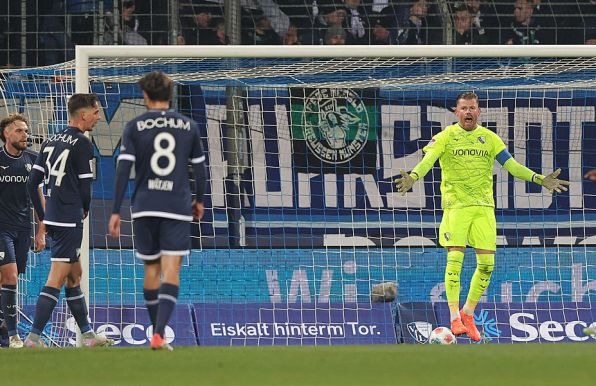
Following VfL Bochum’s 1-2 home loss to Dynamo Dresden, Timo Horn wasn’t just frustrated by the poor first half.
Whether coaches, players, or fans: Pretty much everyone agreed that VfL Bochum lost the game against Dynamo Dresden in the first half.
Timo Horn was no exception: “The first half was obviously weak. We started off well, but then gave Dresden too much space. Especially in the middle, we had no control,” said the goalkeeper.
He was particularly annoyed by the 0-2 goal just before halftime, when Niklas Hauptmann drove the ball “50 meters” down the field, Alexander Rossipal crossed unchallenged, and Vincent Vermeij was able to finish almost unhindered.
Because: “After a half like that, you have to go into the locker room down 0–1; then you have every opportunity in the second half. We saw that. Nevertheless, at 0–2, based on what the guys showed, we actually deserved a point. I don’t think you could have played a better game in the second half.”
And yet there was another point Horn had to grapple with: stoppage time.
“I also have to question the four minutes of stoppage time, which is completely unacceptable,” said the 32-year-old, emphasizing: “We had a rules training session where it was clearly stated that referees want to allow more stoppage time. We had a penalty, Dresden went down three times, the goalkeeper took 20 seconds on every goal kick—so I wanted an explanation for the four minutes as well, but unfortunately I didn’t get one.”
The 0-1 goal, which came after a quickly taken throw-in, also sparked debate during the match. Maximilian Wittek had lightly touched the ball with his head. At least, that was the referees’ decision.
“I thought he wasn’t on the ball. Maybe with the tip of his hair, though I can’t really imagine that with his short haircut. Some things get reviewed, others don’t. But let’s leave it at that,” said Horn. The TV footage, however, suggests that Wittek did in fact touch the ball—albeit very lightly.
What annoyed Horn the most, however, was clearly the fact that VfL Bochum carelessly let three points slip away: “Nevertheless, all in all, it’s very bitter how we lost. When you take everything into account, you shouldn’t lose that way.”