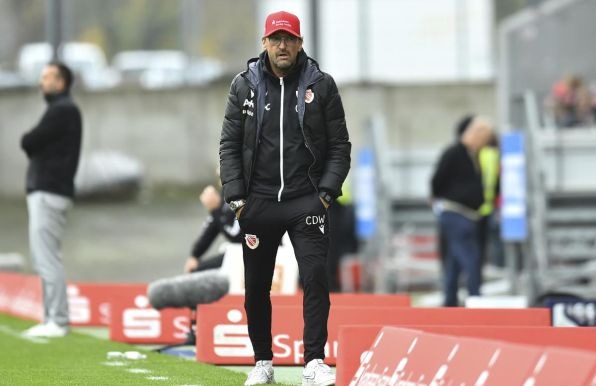
Justin Butler of Energie Cottbus was the victim of racist insults during the match against 1860 Munich. FCE coach Claus-Dieter Wollitz proposed that the game be abandoned.
After the final whistle of 1860 Munich’s 3-0 home victory over Energie Cottbus at Grünwalder Straße, the game itself became a side issue. The victory was overshadowed by derogatory chants, flying beer cups, and monkey noises directed at Energie Cottbus’s Justin Butler by an 1860 fan—an incident that visibly upset him.
“The 1860 Munich executive committee has apologized for this person’s behavior,” Claus-Dieter Wollitz told MagentaSport regarding the scenes after the final whistle. “They don’t need to apologize for that, but I still find it very appreciated,” Wollitz said, praising the gesture. “That’s someone who doesn’t belong here. It’s not 1860’s fault—it’s nobody’s fault. Nobody needs that, nobody wants that.”
There wasn’t much time left to play; 1860 held a comfortable 2–0 lead. So Wollitz suggested to the referee, Konrad Oldhafer, that the game be called off. He would have accepted the loss. Wollitz: “I told the referee he could call off the game to send a message.”
The goal: “Just to make a point, so that everyone stops and thinks. Despite all the emotion. Despite how important it is.” The 60-year-old was clear: “Just to send a message. We’re always talking, but no one takes action. That’s sad for the player, but also sad for 1860 Munich and for everyone else.” Wollitz laments a lack of resolve. “This happens over and over again. No matter who, no matter where, no matter which stadium—none of us have the resolve we should have to call off the game.”
But the referee didn’t call off the game. Wollitz also disagreed with the referee’s penalty kick call before the 1-0 goal (40th minute), which he said turned the game on its head. His assessment: “The game got weird with that penalty kick. Up until then, Energie Cottbus was the better team.”
He sarcastically commented on the certainly justified penalty kick, saying, “It’s always a penalty kick against Energie Cottbus,” and launched into a broader critique: “Where’s the VAR? Where is it? Then we wouldn’t be having these discussions.”