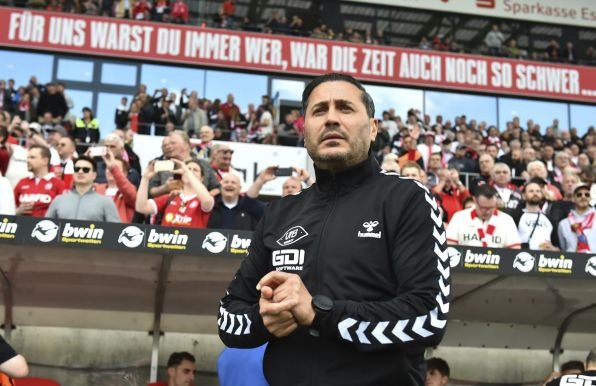
Fuat Kilic is a well-known coach in western Germany’s soccer scene. He has now been out of a job for over a year. We spoke with him.
Fuat Kilic most recently served as coach of VfB Oldenburg on two separate occasions—during the 2023–2024 and 2024–2025 seasons. On August 31, 2024, he was relieved of his duties at the Northern Regional League club and has been unemployed ever since.
Prior to that, the 52-year-old soccer coach and certified physical education teacher enjoyed great success, most notably at Alemannia Aachen. At Tivoli, he served as head coach from January 1, 2016, to June 30, 2020, later also as sporting director, and then again as coach from October 29, 2021, to October 12, 2022.
He also worked as an assistant coach at traditional clubs such as 1. FC Saarbrücken, MSV Duisburg, and 1. FC Kaiserslautern. In Turkey, Kilic—who lives in Cologne—worked for Kasimpasa Istanbul. Kilic does not yet know where his path will take him in the future.
Forecasting spoke with Fuat Kilic.
Fuat Kilic, you’ve been without a coaching job for a year. How have you spent the last twelve months?
Shortly before I was let go by VfB Oldenburg, my father passed away. I needed time to come to terms with this difficult loss. This period of grieving was very important to me. At the same time, I was able to spend a lot of time with my family. In addition, I participated in continuing education courses offered by the BDFL (Association of German Soccer Coaches, Ed.), the DFB, and the German Sport University Cologne. To gain new insights, I also completed an internship with Mr. Thomas Reis in Turkey at Samsunspor.
Be honest: Looking back with what you know now, was taking on your second stint at VfB Oldenburg a mistake? If so, why?
In hindsight, you ask yourself many questions when the collaboration doesn’t go as hoped. I took over the club again during a difficult phase and led it to 5th place in the standings by the end of the season. The goal was to stabilize the club in its first Regionalliga season and compete for promotion in the second year. However, due to the stadium decision, the originally planned sports budget was unexpectedly cut. The new goal was to have a solid season with the existing roster in order to make a push in the third year. Unfortunately, due to my father’s passing, I missed the start of the season and the first game. The weeks that followed also didn’t go as planned, and the club decided to relieve me of my duties.
Would you have liked more support during this difficult phase, which was also hard for you personally?
Of course, as a coach, you always hope for more backing. There were issues within the team that were beyond my control. I’d rather not go into further detail about them. The important thing is to be at peace with yourself. I sincerely wish VfB Oldenburg a speedy return to professional soccer—the city and the fans deserve it. Overall, I look back on 16 intense and wonderful months.
He must be honest, authentic, and, above all, resilient. The fans expect passionate and intense soccer—just as they live and breathe the club themselves. Expectations are high and grow with every victory. You have to be able to handle that while keeping your cool.
Fuat Kilic on the necessary skills for the new Alemannia Aachen coach
Alemannia Aachen, your former club and the one closest to your heart, is currently looking for a new coach. Wouldn’t that be a good fit for you?
Alemannia Aachen is very close to my heart after my long tenure there. For me, the question doesn’t even arise. If my support is needed in any capacity, I’m open to it. This isn’t meant to be an application for a specific position, but I think everyone knows what I’ve done for this club during difficult times. I’ll always carry those special moments in my heart.
You know the city, the club, and the fans inside and out: What kind of person does an Alemannia coach need to be?
He must be honest, authentic, and, above all, resilient. The fans expect passionate and intense soccer—just as they live and breathe the club themselves. Expectations are high and grow with every victory. You have to be able to handle that while keeping your cool.
Soccer is extremely complex. The art lies in combining the team’s development with good results. It’s paradoxical: You can win more tackles, have more shots on goal, and have more possession—and still lose. That’s why the evaluation of a coach’s work shouldn’t depend solely on the result, but also on the team’s style of play and attitude.
Fuat Kilic
Which leagues are you currently eyeing?
For me, it’s crucial that a club has potential for growth and a clear vision—and is willing to professionalize its operations. I don’t limit myself, as I have a broad skill set. I can confidently say that I’m not afraid, regardless of the league. The role doesn’t necessarily have to be that of a head coach. What’s important is that I can identify with the role and am allowed to actively shape it. My goal is to work at a club long-term and build something up.
It seems like coaches are being relieved of their duties earlier and earlier. How do you view this trend?
I’ve experienced it myself and think this trend is heading in the wrong direction. Many clubs talk about long-term development but don’t give themselves the necessary time—often due to pressure to deliver results. Coaches are usually the first to have to take responsibility, regardless of whether they’re to blame for the causes. I admire clubs that consistently stick to their path, even when results aren’t there. SC Freiburg is a role model for me. Often, after setbacks, a momentum builds that’s almost impossible to stop and forces changes.
Are clubs under more pressure these days than they used to be, or are those in charge simply more impatient—and perhaps also unrealistic—when it comes to certain goals?
Sports goals should be set realistically—both internally and externally—to avoid unnecessary pressure. Soccer is extremely complex. The art lies in combining the team’s development with good results. It’s paradoxical: You can win more tackles, have more shots on goal, and have more possession—and still lose. That’s why the evaluation of a coach’s work shouldn’t depend solely on the result, but also on the team’s style of play and attitude.
From a coach’s perspective, what would you like to see?
More openness and transparency from everyone involved in the club. Honest and trusting interactions. More patience and time for the development of players and the team. A clear overall strategy. I’d like to see a different selection process for coaches, so that vacant positions are publicly advertised rather than filled behind closed doors.
You’re 52 years old. You still have a few years until retirement. Can you imagine the next 10 or 15 years without a coaching job—do you have a Plan B ready?
My greatest wish is to continue working in soccer—not necessarily just as a coach, but also in other roles. I’m flexible and open to different options. You have to be prepared for anything in life. That’s why, in addition to my training as a soccer coach, I also earned a degree in sports science and can work in other areas of sports or education.
Who do you think will ultimately win the 3rd League title?
I expect a close race between MSV Duisburg, Energie Cottbus, and Rot-Weiss Essen.
And where will the other 3rd League West clubs—Alemannia Aachen, SC Verl, and Viktoria Köln—end up in the standings?
I think Alemannia Aachen will stabilize and finish safely in mid-table. SC Verl is having another very strong season and could be a dark horse among the top teams. Viktoria Köln deserves a lot of respect: Despite numerous departures—including head coach Olaf Janßen—and the integration of many young players, they’re having a very solid season. I see them finishing at least in the upper mid-table.