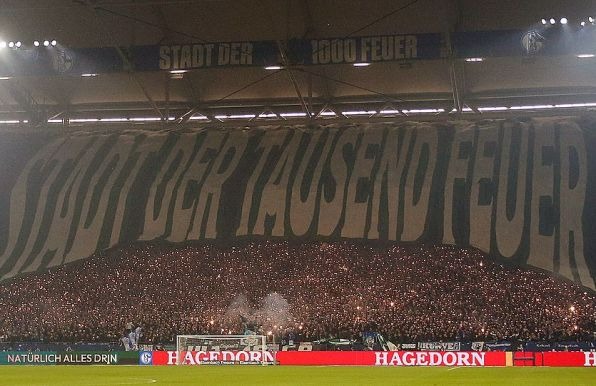
The top match between Ene
Joint Statement on Safety and Fan Culture
The North Rhine-Westphalia clubs from Cologne, Bochum, and Gelsenkirchen are calling on policymakers to find joint solutions regarding stadium safety. The three clubs reject collective penalties.
In recent weeks, many first-division stadiums have observed a moment of silence—at least for the first twelve minutes. Numerous fan groups had previously criticized planned measures by policymakers at the upcoming Conference of Interior Ministers (IMK) in Bremen as amounting to blanket suspicion.
Some points have since been taken off the table. According to Bremen’s Interior Senator Ulrich Mäurer (SPD), personalized tickets, widespread ID checks, facial recognition, AI surveillance, and pyrotechnics are not on the agenda for the three-day conference.
This has taken some of the heat off the issue. On Thursday, 1. FC Köln, FC Schalke, and VfL Bochum issued a joint statement regarding the current debate on stadium security and the deliberations of the Conference of Interior Ministers.
The statement notes that, for the clubs signing this statement, a vibrant and diverse fan culture is an integral part of their clubs and traditions. At the same time, the protection of all stadium visitors is, of course, an absolute priority. And these two aspects go hand in hand.
Only a continuous, fact-based dialogue can strike a balance between high security and a vibrant fan culture.
Schalke, VfL Bochum, 1. FC Köln
The statement explains: “In the run-up to the IMK, we are already in close communication with political leaders—particularly at the state level. Likewise, the North Rhine-Westphalia clubs are coordinating closely with one another, with the associations, and with the relevant bodies of German soccer. Our primary concern is to make the discussion more objective. For we are convinced that only a continuous, fact-based dialogue can strike a balance between high security and a vibrant fan culture.”
The clubs emphasize that the stadium experience in German stadiums is safe, and that the numbers speak for themselves. However, they understand that policymakers are also under pressure due to the large number of law enforcement officers required to monitor the games.
The three clubs write: “These issues were discussed in depth within the Federal-State Open Working Group (BLoAG) among the DFB, the DFL, the ministries of the interior, and law enforcement agencies. For us, one thing is clear: stadium bans must be based solely on verifiable facts. They are subject to the principle of proportionality, and the rights of those affected must be safeguarded. There must be no automatic rule whereby mere initial suspicion alone results in a stadium ban.”
In general, the three clubs oppose collective punishments and appeal to policymakers to find solutions together. Ultimately, safety must be ensured, but the “unique fan culture” must be preserved.
The full text of the statement
Joint Statement by North Rhine-Westphalian Soccer Clubs on the Current Debate Regarding Stadium Safety and the Deliberations of the Conference of Interior Ministers.
The soccer clubs in North Rhine-Westphalia are following the nationwide discussion on stadium safety, fan culture, and possible new measures by the Conference of Interior Ministers (IMK) with great attention. For the signatories of this statement, one thing is clear: the vibrant and diverse fan culture is an essential part of our clubs and our shared soccer tradition. At the same time, the safety of all stadium visitors is our top priority. Both aspects go hand in hand and must not be pitted against one another.
In the run-up to the IMK, we are already in close communication with political leaders—particularly at the state level. Likewise, the NRW clubs are coordinating closely with one another, with the associations, and with the relevant bodies of German soccer. Our primary goal is to keep the discussion objective.
For we are convinced that only a continuous, fact-based dialogue can strike a balance between high security and a vibrant fan culture.
The current debate is taking place even though the stadium experience in Germany is demonstrably safe—as evidenced by figures from the Central Information Office for Sports Operations (ZIS). At the same time, we recognize that the heavy deployment of police resources poses challenges for policymakers. However, the measures currently under discussion go far beyond what is necessary and would deeply encroach upon fan culture, club autonomy, and the rights of visitors.
These issues were discussed in depth within the Federal-State Open Working Group (BLoAG) by the DFB, the DFL, state interior ministries, and police authorities. For us, one thing is clear: stadium bans must be based solely on verifiable facts. They are subject to the principle of proportionality, and the rights of those affected must be safeguarded. There must be no automatic mechanism whereby mere initial suspicion alone results in a stadium ban.
Furthermore, stadium safety is a local responsibility. Each venue bears a special responsibility toward its own fans, the local community, and soccer as a whole.
We view positively the agreed-upon strengthening of the clubs’ safety and prevention efforts. This begins where security actually takes shape: through the coordinated cooperation of all local partners.
We expressly oppose blanket and collective restrictions—such as comprehensive ticket personalization, curtailing the work of local stadium ban commissions, or general infringements on the rights of visiting fans. Instead, we advocate for evidence-based, nuanced measures and for trust-based cooperation between clubs, fan projects, fan communities, authorities, and associations. This is the only way to achieve prevention, effectiveness, and acceptance in equal measure.
We call on political decision-makers to shape this path together with us. Developments in recent years clearly show that objectivity, prevention, and local responsibility yield more sustainable results than blanket tightening of regulations. The goal of all stakeholders must be to further strengthen safety while preserving the unique fan culture that has shaped German soccer for decades.
We will follow the ongoing process of the Conference of Interior Ministers constructively, critically, and resolutely—with the clear goal of reconciling safety and fan culture and conducting the debate on a factual basis.
1. FC Köln
Schalke 04
VfL Bochum
Rösler on Strompf: “We never let anyone in the family down”
It didn’t take long to identify the unlucky player of the evening at VfL Bochum. Philipp Strompf apologized in the locker room for his mistakes, but from the rest of the team, there were only words of encouragement.
Philipp Strompf was the unlucky player on Wednesday evening as VfL Bochum was eliminated from the cup by VfB Stuttgart. First, he caused the own goal that made it 0–1; shortly before halftime, he was sent off following a VAR review for a professional foul.
It was a rough night, but no one blamed him. On the contrary: In the locker room, the center back apologized to the team.
Bochum’s coach, Uwe Rösler, explained afterward: “I was moved by how he said it, how he conveyed it. And I think that went over very well with everyone in the locker room.”
He added: “He’s family, and we never let anyone in the family down. You can make mistakes, but what matters is how you bounce back from them. I have no doubts about Pippo in that regard.”
Left back Maximilian Wittek also came to the coach’s defense. “Of course Pippo was down, but it happens—you have an off day. We’ll lift his spirits quickly now; that’s what a team is for. Pippo has become a key pillar of the team, plays at a very high level, and we’ll need him again on Saturday.”
That’s when they’ll face Arminia Bielefeld at the Ruhrstadion. And the Bochum players want to build on what they’ve started in recent weeks. After all, the trend—as their performance against VfB also showed—is heading in the right direction.
Wittek also emphasized after the game against the defending DFB Cup champions that the team could be very satisfied, because: “The most important thing is that we can say after the game that we gave it our all. If you look at how the game unfolded, things couldn’t have gone any more unluckily for us. Going down 0–2 right after halftime was more or less the deciding factor. But we didn’t concede any more goals, which shows that we’ve continued to improve and have made progress over the past few weeks.”
And now we need to build on that when Bielefeld comes to Bochum on Saturday. Wittek looks ahead: “Advancing would, of course, have been a nice bonus, but our full focus is on the league and now on Bielefeld on Saturday. We need to recover well now and go into that match with full energy.”
Energie Cottbus and MSV Duisburg are set for a battle at the top of the table. MSV coach Dietmar Hirsch will be without one of his key players.
When Energie Cottbus hosts MSV Duisburg on Saturday (December 6, 2 p.m.) for the top-of-the-table clash of Matchday 17 in the 3. Liga, nothing less than the top spot in the standings is at stake for both teams. Duisburg coach Dietmar Hirsch and his team aim to defend their position at the top with a win.
Second-place Cottbus is tied on points with Duisburg and trails by just one goal in goal difference. Should both teams split the points this weekend, third-place SC Verl could also jump to the top of the standings, provided they win their away match against TSV Havelse.
MSV coach Hirsch is already fired up for the upcoming match. He notes that it’s not a given that two teams would face off in such a top-tier matchup at this point in the season, and that both teams have more than earned this showdown based on their performances so far.
“There will be a great atmosphere, and it will be a positively intense and emotional match. Cottbus is a team that rightfully belongs up there; they defend very well and, above all, have a very compact formation. That means we’ll have to be very patient with the ball,” Hirsch explained at the pre-match press conference.
We have to try to keep the opponent out of our penalty area and impose our game through both quick transitions and calm periods of possession
Dietmar Hirsch
Furthermore, Duisburg’s successful coach warned about the individual quality of the upcoming opponent. In particular, Tolcay Cigerci (11 goals, 6 assists) and Erik Engelhardt (10 goals, 1 assist) are players capable of making the difference.
“They play very boldly with the ball and have a strikingly high number of players in the box. At times, they have five or six players in the box, and there’s always a lot going on there,” Hirsch explained. “We have to try to keep the opponent out of our box and impose our game through both quick transitions and composed periods of possession.”
Against Cottbus, Hirsch will have to do without key player Joshua Bitter. During Duisburg’s 3-1 win over Alemannia Aachen last matchday, the right back received his fifth yellow card and is therefore suspended for the upcoming top-of-the-table clash.
“Mert Göckan would be one option to replace him, but that doesn’t have to be the final decision. We’re trying out a few things and still have other options,” Hirsch revealed. “Leon Müller has already played in that position, and Niklas Jessen is also a natural right back. So we have a few options we can fall back on.”
The roughly 1,000 traveling MSV fans will find out by Saturday afternoon at the latest who will ultimately take Bitter’s place in the starting lineup and whether Duisburg can defend its top spot in the standings.